
Professional services · 7 min read
Accountant Email List Building Guide
A practical guide for accountants who want to build an email list from social posts, LinkedIn attention, and helpful small-business resources.
- Accountants should build email lists around practical business questions, not generic newsletter signups.
- Good first resources include record-keeping checklists, tax deadline planners, bookkeeping setup guides, and year-end preparation worksheets.
- Each download should lead to a useful follow-up question that starts a real advisory conversation.
Why email matters for accountants
Accounting advice is often needed before the client is ready to switch firms or book a consultation. A business owner may be confused about records, deadlines, expenses, payroll, VAT, bookkeeping software, or year-end preparation long before they ask for help.
An email list gives the accountant a way to stay useful during that decision window. The list should not be built around a vague newsletter promise. It should be built around resources that solve immediate business admin problems.
The strongest list is not necessarily the biggest. It is a list of business owners who downloaded something that reveals what they are trying to fix.
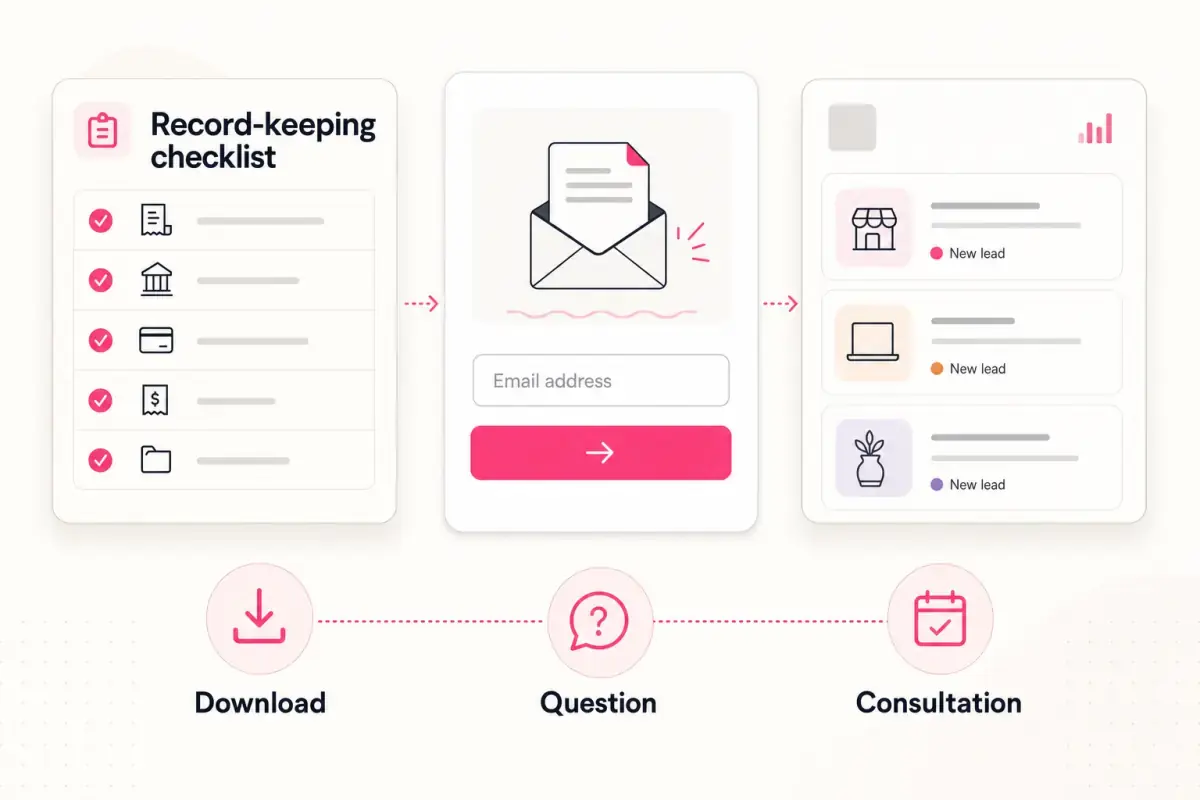
A useful checklist tells the accountant what problem the lead is trying to solve.
Givloh editorial note
The best first resources
Accountants have a natural advantage because clients already need checklists and reminders. Good first resources include a self-employed record-keeping checklist, a monthly bookkeeping routine, a year-end preparation worksheet, a tax deadline planner, or a 'what to send your accountant' checklist.
Choose a topic that connects to the work the accountant wants more of. For monthly bookkeeping clients, use a routine checklist. For advisory clients, use a cash-flow or planning worksheet. For new business clients, use a setup checklist.
Avoid giving legal or tax advice that depends on the reader's exact situation. Keep the resource practical and encourage professional advice when needed.
Strong accountant lead magnet formats
- Record-keeping checklist.
- Monthly bookkeeping routine.
- Year-end preparation worksheet.
- Tax deadline planner.
- Questions to ask before hiring an accountant.
How to share it
LinkedIn is a strong channel for accountants because business owners and referral partners are already there. Instagram and Facebook can work for simpler educational posts, especially for sole traders and local business owners.
Each post should answer one narrow question and point to the resource. For example: 'Most year-end delays come from missing records. I made a one-page checklist of what to gather before you send anything to your accountant.'
If the resource is a PDF, the delivery flow can follow the same pattern as the guide to delivering a free PDF from your Instagram bio.
A simple content loop
- Answer one common client question in a post.
- Offer the full checklist through the bio or profile link.
- Capture the email before delivery.
- Follow up with one practical next question.
What to send after the download
The follow-up should match the resource. Someone who downloads a record-keeping checklist can be asked whether they are using software, spreadsheets, or paper receipts. Someone who downloads a year-end worksheet can be asked when their accounts are due.
A simple question is often better than a polished sales sequence. It lets the accountant understand urgency, business type, and fit.
The resource earns the email. The first reply starts the advisory relationship.
Use this as the starting checklist
- Pick one client problem for the first resource.
- Make the resource practical, not generic.
- Avoid situation-specific tax advice inside the PDF.
- Use LinkedIn posts to preview individual checklist items.
- Follow up with one helpful qualifying question.
References and useful next reading
Givloh
Turn the resource into a lead capture page.
Upload a guide, checklist, template, or tool. Share one link. Capture the email before the download. No Mailchimp, Zapier, Drive permissions, or landing page builder.
Try Givloh freeFAQ
How can accountants build an email list?
Accountants can build an email list by offering practical resources such as record-keeping checklists, deadline planners, and bookkeeping worksheets behind an email gate.
What lead magnet works for accountants?
A self-employed record-keeping checklist or year-end preparation worksheet is a strong first lead magnet because it connects to urgent client admin.
Should accounting content include tax advice?
Public lead magnets should stay practical and general. Situation-specific advice should happen in a professional consultation.